
Thomas F. Lahr,
U.S. Geological Survey
Slide 1:
WorldWideScience.org
Providing Global Access to World Science: Overcoming
Standards Challenges Through Federated Search
 CODATA 2008, Kyiv, Ukraine
Thomas F. Lahr US Geological Survey
Reston, VA USA
Co-Chair, US Science.gov Alliance
Alternate US Representative, WorldWideScience.org Alliance
Slide 2: Why WorldWideScience.org?
There is a need to find national scientific and technical information quickly and easily, but information is dispersed across thousands of web sites ("Surface Web") in addition to being found within databases or portals ("Deep Web").
Slide 3: Surface Web vs Deep Web 2005
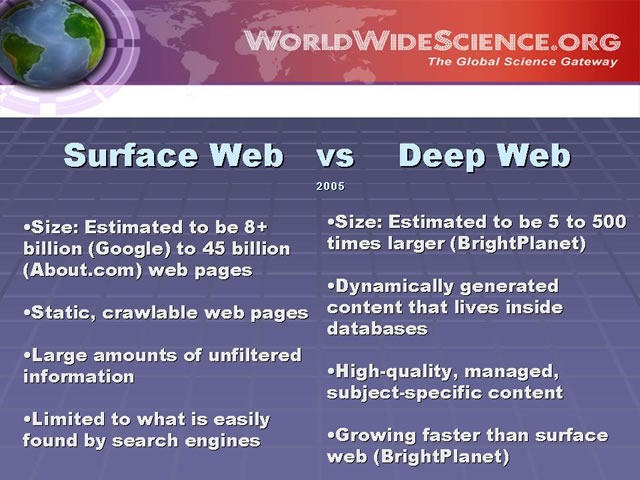
- Size: Estimated to be 8+ billion (Google) to 45 billion (About.com) web pages
- Static, crawlable web pages
- Large amounts of unfiltered information
- Limited to what is easily found by search engines
- Size: Estimated to be 5 to 500 times larger (BrightPlanet)
- Dynamically generated content that lives inside databases
- High-quality, managed, subject-specific content
- Growing faster than surface web (BrightPlanet)
Slide 4: National Science Portals Collaboration and Coordination
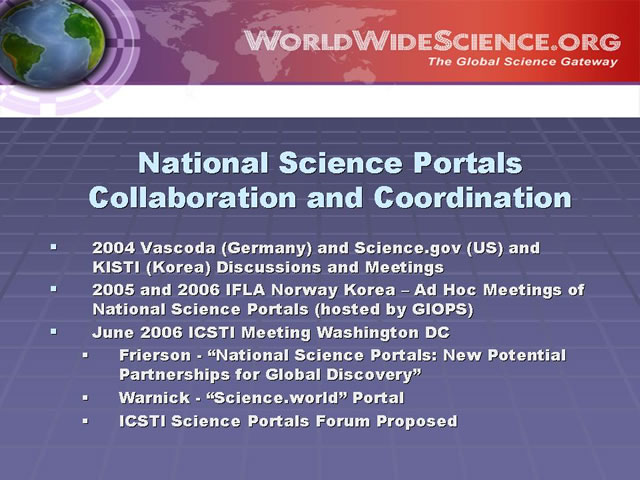
- 2004 Vascoda (Germany) and Science.gov (US) and KISTI (Korea) Discussions and Meetings
- 2005 and 2006 IFLA Norway Korea – Ad Hoc Meetings of National Science Portals (hosted by GIOPS)
- June 2006 ICSTI Meeting Washington DC
- Frierson - "National Science Portals: New Potential Partnerships for Global Discovery"
- Warnick - "Science.world" Portal
- ICSTI Science Portals Forum Proposed
Slide 5: ICSTI Science Portals Forum Proposal
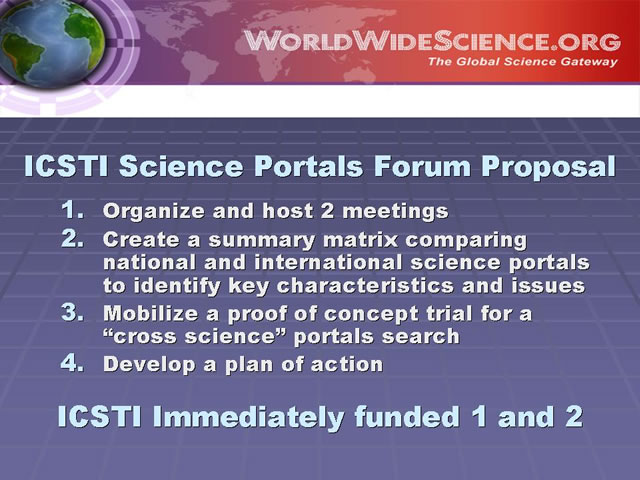
- Organize and host 2 meetings
- Create a summary matrix comparing national and international science portals to identify key characteristics and issues
- Mobilize a proof of concept trial for a "cross science" portals search
- Develop a plan of action
ICSTI Immediately funded 1 and 2
Slide 6: 1. Organize and host 2 meetings
January 2007 - ICSTI winter meeting in London
June 2007 - ICSTI meeting Nancy
Slide 7: 2. Create a summary matrix comparing national and international
science portals to identify key characteristics and issues
- What is a portal?
- How to define scope and coverage
- Intellectual property rights management
- Search techniques- browse taxonomies, site searching, deep web, metadata, data, publications Languages
Slide 8: US DOE/BL Agreement
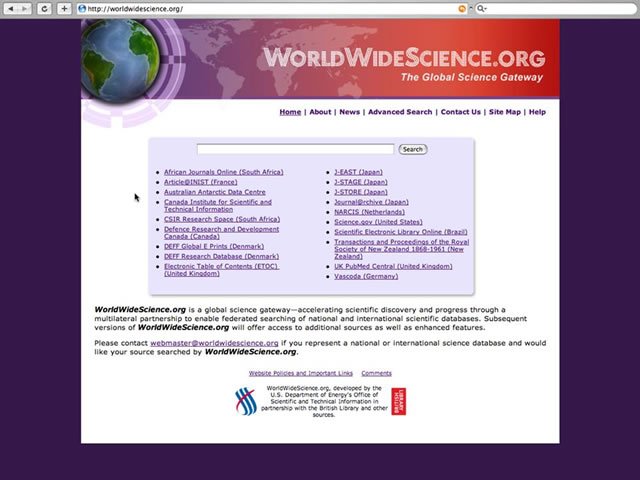
In January 2007 the US Department of Energy and the British Library agreed to partner to develop a global science gateway to accelerate scientific discovery
Slide 9:
WorldWideScience.org
 June 2007 demonstration
- 12 databases/10 countries
- Invited others to join in developing governance documents-Feb 2008
Slide 10: How Does the WorldWide Science Gateway work?
The approach is to capitalize on existing "federated search" technology to search collections of science information distributed across the globe.
This enables much-needed access to both prominent as well as smaller, less well-known sources of highly valuable science.
Users simply submit a single query into the WorldWideScience.org search engine to launch simultaneous searching of the databases and portals of participating nations.
Results are returned in relevance-ranked order.
Slide 11: WorldWideScience.org
Slide 12: WorldWideScience Alliance
- June 12, 2008 Seoul, Korea signing ceremony for this multilateral alliance
- 11 founding member organizations
- Representing 38 countries
- ICSTI is sponsor
Slide 13: WorldWideScience Alliance Signing Ceremony
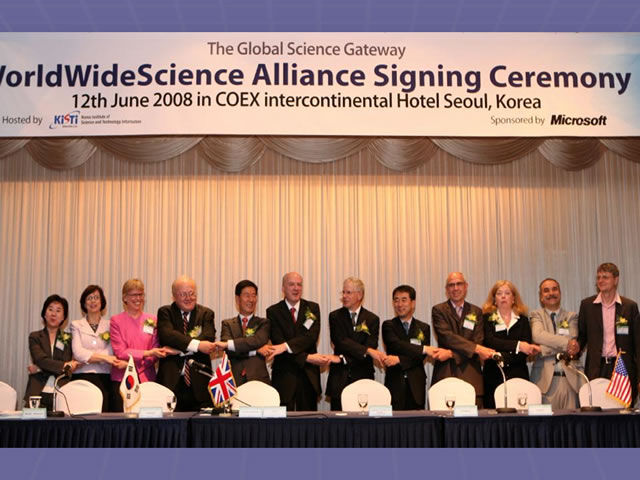
12th June 2008 in COEX intercontinental Hotel Seoul, Korea
Slide 14: Current National Partners in WorldWideScience.org
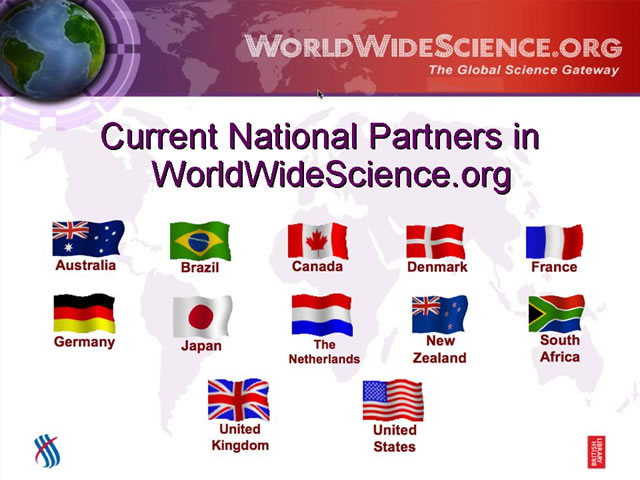
Australia
Brazil
Canada
Denmark
France
Germany
Japan
The Netherlands
New Zealand
South Africa
United Kingdom
United States
Slide 15: WWS.org Databases and Portals
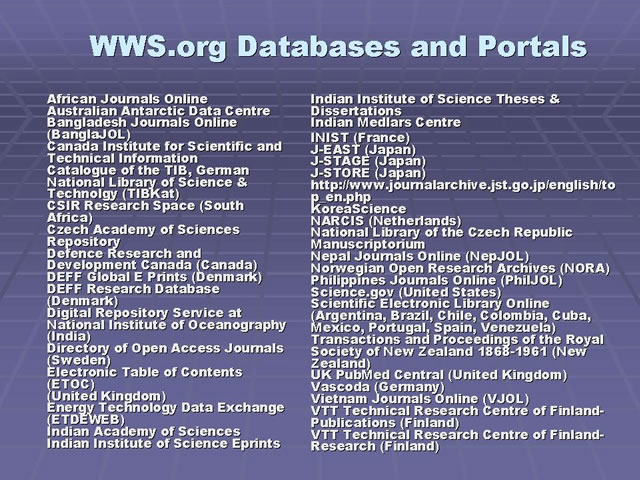
- African Journals Online
- Australian Antarctic Data Centre
- Bangladesh Journals Online (BanglaJOL)
- Canada Institute for Scientific and Technical Information
- Catalogue of the TIB, German National Library of Science & Technolgy (TIBKat)
- CSIR Research Space (South Africa)
- Czech Academy of Sciences Repository
- Defence Research and Development Canada (Canada)
- DEFF Global E Prints (Denmark)
- DEFF Research Database (Denmark)
- Digital Repository Service at National Institute of Oceanography (India)
- Directory of Open Access Journals (Sweden)
- Electronic Table of Contents (ETOC) (United Kingdom)
- Energy Technology Data Exchange (ETDEWEB)
- Indian Academy of Sciences
- Indian Institute of Science Eprints
- Indian Institute of Science Theses & Dissertations
- Indian Medlars Centre INIST (France)
- J-EAST (Japan)
- J-STAGE (Japan)
- J-STORE (Japan) http://www.journalarchive.jst.go.jp/english/top_en.php
- KoreaScience
- NARCIS (Netherlands)
- National Library of the Czech Republic Manuscriptorium
- Nepal Journals Online (NepJOL)
- Norwegian Open Research Archives (NORA)
- Philippines Journals Online (PhilJOL)
- Science.gov (United States)
- Scientific Electronic Library Online (Argentina, Brazil, Chile, Colombia, Cuba, Mexico, Portugal, Spain, Venezuela)
- Transactions and Proceedings of the Royal Society of New Zealand 1868-1961 (New Zealand)
- UK PubMed Central (United Kingdom)
- Vascoda (Germany)
- Vietnam Journals Online (VJOL)
- VTT Technical Research Centre of Finland-Publications (Finland)
- VTT Technical Research Centre of Finland-Research (Finland)
Slide 16: WorldWideScience.org
A rapidly growing gateway to
scientific and technical information
databases and portals around the world.
Thank You!
 |
 |
 |
WorldWideScience.org is maintained by the
U.S. Department of Energy's |